

Introduction
The distribution sector is thriving at a rapid pace amid complex supply chains and razor-thin margins. The need for quicker and more accurate fulfillment poses a big challenge for wholesale distributors. In such a scenario, the strategic adoption of advanced wholesale distribution industry software can help them with integration and automation. This software offers real-time data visibility to transform fulfillment troubles into opportunities.
In this post, we will understand the top software opportunities that transform the wholesale distribution business. But before moving ahead, let’s understand the core operational challenges and how modernization can assist distributors to get rid of them.
Core Operational Challenges That Distributors Face
The biggest hurdle for any wholesale distribution business in Canada is logistical complexities. Vast distances, extreme weather conditions, and the concentration of the population near the US border are some of the major operational challenges for distributors. These challenges lead to massive freight costs and long lead times. Legacy systems may fail to address these challenges effectively due to inefficiencies and a lack of real-time visibility.
Modernization can address these challenges by enabling the wholesale distribution companies to optimize complex routes and offer accurate order tracking to customers. Impact of Modernization on the Wholesale Distribution Business Modernization is a strategic move for wholesale distributors as it can transform their business into a smart and data-driven service hub. Integrated systems, including sophisticated ERPs, WMS, and AI-driven analytics, can automate and optimize tasks. This modernization enables wholesale distributors to reduce the chances of manual errors and high fulfillment costs.
Moreover, it plays a vital role in meeting the changing demands of B2B customers with personalized experiences. Let’s dig deeper into the top opportunities of the wholesale distribution industry software for distributors.
Top Software Opportunities to Transform Wholesale Distribution
Integrated and centralized operational software can handle the challenges related to fragmented data, manual processes, and logistical complexities. Advanced Enterprise Resource Planning (ERP) and a dedicated Warehouse Management System (WMS) provide distributors with end-to-end supply chain visibility in real time. These solutions offer centralized control for automating repetitive, high-volume tasks, including order processing and invoicing.
Another major opportunity for wholesale distribution businesses is that they can leverage technology to drive customer-centric growth and strategic intelligence. A robust B2B eCommerce platform and CRM tools can help them meet the high expectations of the retail world with 24/7 services. Additionally, the integration of AI and ML can give them a competitive edge by offering predictive analytics. This can increase efficiency and accuracy.
Key Benefits of Software Driven Modernization
The paradigm shift from traditional to software-driven processes can yield massive benefits for distributors. Here are some of the business benefits of software-driven modernization.
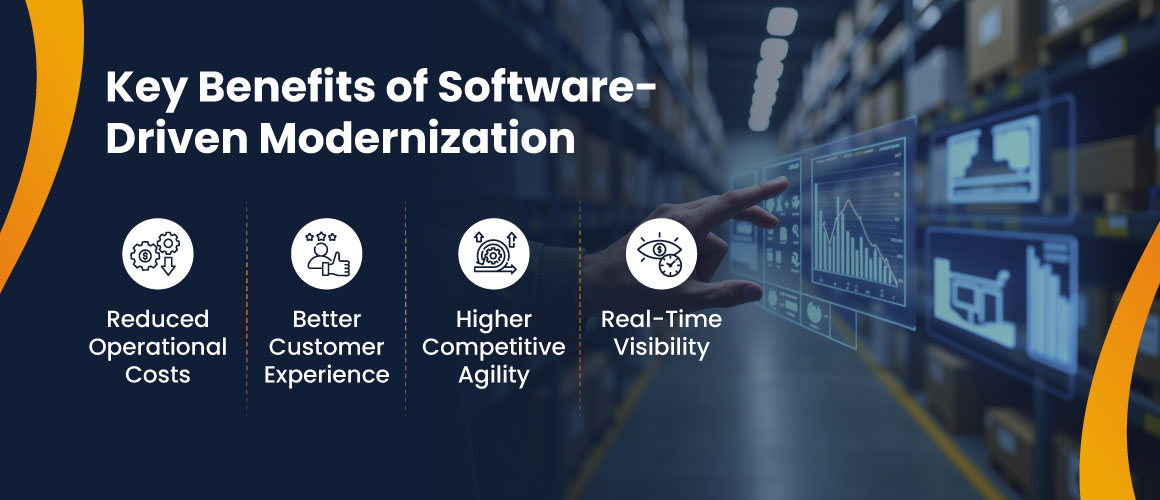
Reduced Operational Costs
Automation of ordering and invoicing can reduce manual labor costs and other overheads significantly. Furthermore, automation can save time and eliminate the chances of costly human errors during the order fulfillment process.
Real Time Visibility
Integrated systems like ERP and CRM can give wholesale distributors a single source of truth. These solutions are useful to get accurate data on inventory levels and order status instantly. It is essential for quicker decision-making.
Better Customer Experience
Omnichannel platforms enable B2B customers to interact with wholesale distributors in the way they want. This offers them convenience and speed with a personalized B2C expreience. This leads to repeat business with loyal retailers.
Higher Competitive Agility
Advanced analytics and flexible systems assist distributors to make insightful decisions. They can adjust pricing and otpmize stock levels as per the prediction to stay ahead of market changes. This results in higher agility and more resilience. However, it is essential to make an effective roadmap to ensure the successful modernization of the distribution business.
Implementation Roadmap for Distributors
Building a successful roadmap for a feature-rich wholesale distribution industry software implementation consists of three phases. First and foremost is the Discovery and Selection phase. Here, distributors should audit their current systems and define pain points. They can select the right integrated platform based on their requirements. The second phase is Configuration and Data Migration. This is the most important phase that makes the selected software customized for specific requirements by migrating all historical data safely.
Rollout and Training is the final phase that demands role-specific training for all employees of wholesale and distribution companies. Finally, it is better to opt for post-implementation optimization to monitor KPIs and collect valuable feedback. This can help distributors refine processes to maximize the ROI.
Real World Examples of Software Driven Scaling
The wholesale distribution world can scale with powerful software. Here are two real-world examples of software-driven growth.
E-Commerce Revolution
A large industrial parts distributor based in Canada relied on phone and fax orders. They invested in a modern B2B eCommerce platform to address rising competition from online marketplaces. They integrated this platform with advanced ERP system and offered their commercial customers personalized pricing and placing large orders for 24/7 basis.
Within 2 years, they found that over 40 percent of their B2B sales were originating from the web channel. This single eCommerce platform with ERP integration gave them a global reach.
F&B Optimization
A regional food and beverage distributor sttugled with massive fuel costs and razor-thin margins due to inefficiency in delivery route planning. They implemented a new SAP solution for warehouse management and integrated a route optimization software. This eliminated the manual and guesswork-based route planning process, resulting in 15 percent reduction in total annual fuel consumption.
The SAP Business One software implementation was pure scaling and enabled them to increase their delivery throughput significantly. The distributor could serve a much larger geographical area without purchasing a single new truck.
However, it is necessary to select a reputable software development pattern to leverage the benefits of software-driven modernization.
Concluding Remarks
Geographical and logistics challenges can halt the growth of wholesale distribution companies in Canada. They need feature-rich and advanced software to modernize ordering and other processes. The software-driven modernization offers distributors a competitive edge by reducing operational costs and automating workflows. However, it is crucial to choose the right software development partner to leverage these benefits and scale the distribution business.
Silver Touch Technologies Canada is your trusted software development partner. We offer the best-in-class services from consulting to implementation for Canada-based companies and assist them in driving growth. Contact us to know more about our 360-degree enterprise software development services for transforming processes through automation.
FAQs
Modernization is important because it enables US distributors to meet increasing customer expectations for speed and transparency. It is also useful for addressing intense pressure from rising supply chain costs and volatility.
Integrated wholesale distribution solutions like ERP systems remain most effective for wholesale distributors because they can unify inventory, finance, and logistics.
Distributors can reduce operational bottlenecks with software by automating manual data entry, streamlining order-to-case cycles, and getting real-time inventory visibility across all channels.
The first steps to implementing digital tools in the distribution business are assessing current pain points, choosing a scalable ERP for US distributors, and focusing on a rapid deployment with best practices.
Distributors expect measurable benefits, such as reduced inventory holding costs, faster order fulfillment, improved accuracy, and a significant increase in overall productivity, after modernizing.
Distributors ensure the successful adoption of new technology by involving key team members early in the selection process and prioritizing comprehensive user training.