

Odoo ERP + CRM for Canadian Businesses
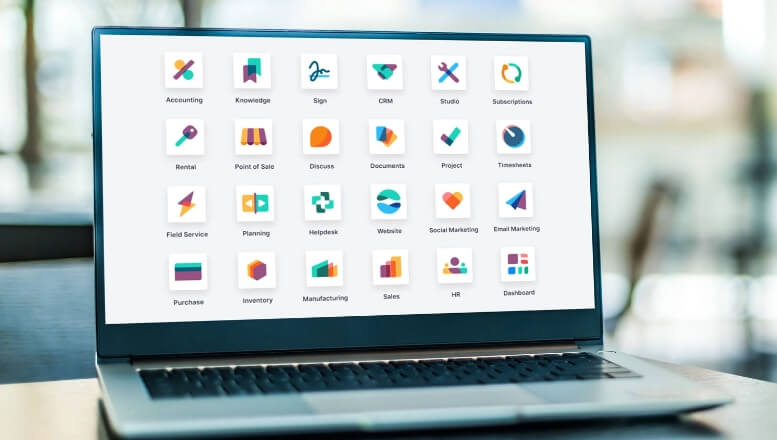
Odoo is a modular ERP platform that includes CRM, accounting, inventory, sales, manufacturing, and more all within a single unified system. Canadian companies can start with essential modules and add capabilities as they grow, giving them flexibility without a heavy upfront commitment.
Many Canadian small and mid-sized businesses choose Odoo because it offers a full business suite with CRM functionality included, easier customization, and lower total cost of ownership. Its user-friendly interface and smoother learning curve help teams adapt quickly and keep operations aligned across departments.

12 Million + Users

44,000 +Integrated Apps

1 to 24 MonthsTo be Implemented

3,600 +Employees

Salesforce CRM for Canadian Businesses
Salesforce is a leading CRM platform used worldwide to manage customer relationships, sales pipelines, marketing automation, and customer service operations. Canadian organizations adopting Salesforce benefit from its deep CRM functionality, advanced analytics, and powerful integration capabilities with other enterprise systems.
Salesforce is best suited for businesses that prioritize customer engagement, marketing automation, and sales forecasting. While Salesforce excels at CRM, it often requires integrations with other platforms for comprehensive ERP features such as finance, inventory, or manufacturing.
150000 +Users
7000 +Apps
630 +Resellers
56000 +Employees
Odoo vs Salesforce in Canada: Choosing the Right ERP + CRM Solution
Choosing the right business platform is a strategic decision for Canadian organizations aiming to streamline operations, enhance customer engagement, and support sustainable growth. Odoo and Salesforce are both widely adopted solutions in Canada, but they address different business priorities and operational approaches. Odoo functions as a flexible, all-in-one ERP platform, while Salesforce is primarily focused on customer relationship management and sales automation.
Canadian businesses must consider factors such as cost, scalability, customization, and integration requirements when comparing the two. Each platform offers distinct advantages depending on company size and digital maturity. This comparison helps Canadian organizations identify which solution aligns best with their operational goals and long-term strategy.
Features Comparison
Inventory Management


Cloud data storage

Contact database
Linked contacts
Contact enrichment

Client list
Product catalog
Internal notes
Customizable form fields
Customizable funnel
Kanban Funnel
Drag and drop opportunities into the Kanban pipeline
Activity scheduling
Activity triggers
Activity reminders
Calendar of activities
Lead List
Category tags
Priority markers
Predictive Lead Scoring
Manual Lead Scoring
Seller Profiles
Sales Team
Team Funnels
Team Calendars
Availability sharing
Lead Assignment (Automatic)
Lead Assignment (Manual)
Gamification
Chat History
Direct Messages/Live Chat
Opportunities Page Email
Confirmation emails
Send documents by email
Email Templates
Document Preview
Online customer portal
VoIP
WhatsApp Integration
Website Visit Leads
Contact Form Leads
Marketing Ads Leads
Leads from received emails
Event Registration Leads
Leads from Appointment Scheduling
Lead Mining
Lead enrichment
Quote Builder
Quotation templates
Import/Export Sales Orders
Upsell and Cross-Sell
Optional products
Electronic signature in quotations
Online payments
Invoice management from sales orders
Delivery status visible on orders
Scheduled delivery dates
Gift Cards
e-Wallet
Coupons
Promotional programs
Price rounding
Price lists
Multiple prices per product
Marketing Campaign Tracking
Lead Source Tracking
Reasons for missed opportunities
Customizable reports
Customizable panels
Customizable KPIs
Analytics
Order and billing analysis
Forecast report
Download as Excel file
Import spreadsheets
Real-time spreadsheets
Multiple chart options
Pivot table in multiple dimensions
Multiple users
Different languages
Various currencies
Miscellaneous taxes
Different types of access rights
API Access
Gmail
Outlook
Amazon
eBay
Carriers (FedEx, DHL, etc.)
Payment collectors (Stripe, etc.)
Full web interface
Mobile App
Android App
iPhone App
The Right Fit for Different Business Needs
The consideration of which solutions to adopt Odoo ERP or Salesforce CRM – always comes down to budget, size and purposes of the business: Salesforce is great for multi-national companies that have to manage a variety of different customers. Due to its diverse set of features, it is the go to software for businesses dealing with great quantities of clients. The deep association that it carries with the rest of its ecosystem enables it to flourish as such large enterprises tools. Salesforce is an all in one solution. By using odoo you will be more prone to being fit for a more specific solution as it is open sourced, which means you could tweak it to fit your needs. In contrast with odoo, Salesforce is far more useful for enterprises that are specifically searching for a management solution for their industry.| Comparison Factor | Odoo (ERP + CRM) | Salesforce (CRM) |
|---|---|---|
| Core Focus | Unified ERP + CRM | CRM and customer engagement |
| Business Size | Ideal for SMEs and growing companies | Used by SMBs and enterprises |
| Cost & Licensing | More predictable and affordable | Higher subscription and integration costs |
| Customization | Modular and open-source flexibility | Extensive CRM customization |
| Implementation Timeline | Faster for integrated ERP + CRM | CRM deployment faster, ERP requires integration |
| User Experience | Unified business view | Best-in-class CRM experience |
| Scalability | Grows with business needs | Scales strongly for sales and service teams |
Exploring Odoo vs Salesforce in Canada: Choosing the Right ERP + CRM Solution
Both Odoo and Salesforce deliver powerful capabilities, but the right choice depends on organizational priorities
Looking for ERP & CRM Guidance?
Work with experienced consultants to evaluate your business
processes and choose the platform that fits your growth plans.
More Odoo ERP Comparisons
Odoo Vs Microsoft Dynamics
Odoo Vs SAP
Odoo Vs Netsuite
Odoo vs Quickbooks
FAQs
Odoo is a full ERP platform that includes CRM as part of its integrated suite, while Salesforce is primarily a CRM focused on sales, marketing, and customer service.
Yes, Odoo can handle core CRM needs such as lead management, sales pipelines, and customer communication, especially for businesses looking for an all-in-one system.
Odoo is better suited for end-to-end operations since it combines CRM, accounting, inventory, and operations in one system, whereas Salesforce focuses mainly on customer engagement.
Yes, Salesforce typically needs third-party ERP integrations to manage finance, inventory, or manufacturing processes.
Both platforms scale well, but Odoo scales by adding modules as needed, while Salesforce scales primarily within sales, service, and marketing functions.