
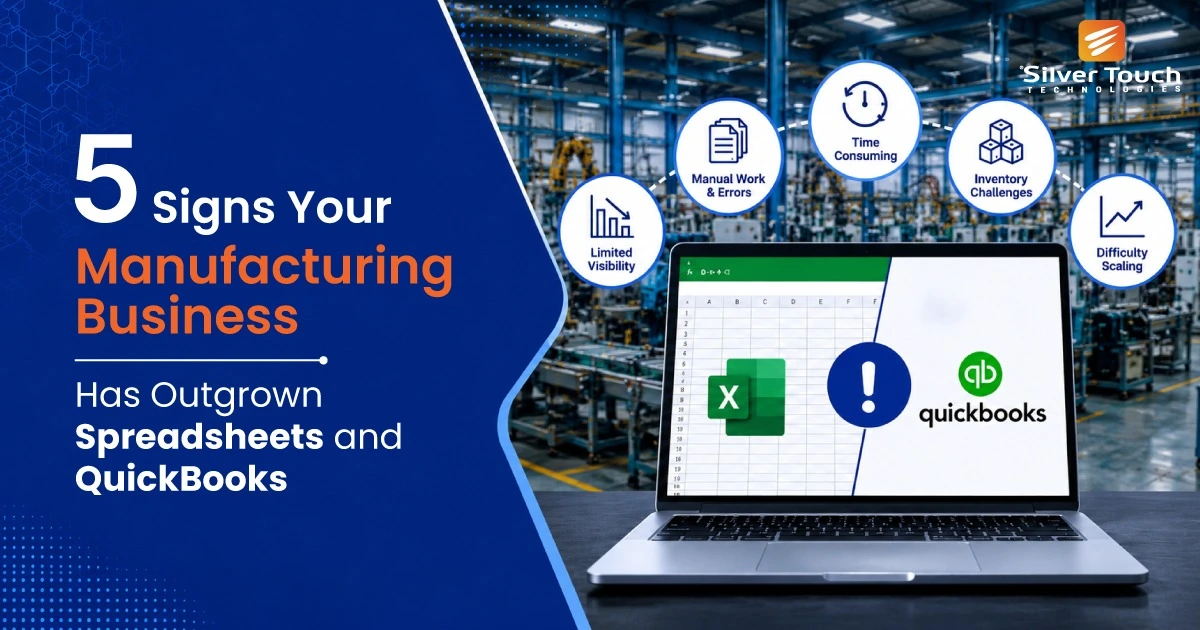
Spreadsheets and QuickBooks are rarely a bad decision. For a young manufacturing business, they’re fast to set up, cheap to run, and familiar to almost everyone on the finance team. The problem isn’t how you started — it’s what happens when the business outgrows the tools before anyone notices.
For a CFO or COO, that gap shows up as longer month-end closes, inventory numbers nobody fully trusts, and a growing pile of manual reconciliations. None of it looks like a crisis on any single day. Together, it’s a warning sign. Here are five of them worth watching for.
1. Month-End Close Keeps Getting Longer, Not Shorter
A close that took three days last year and takes seven or eight now isn’t a staffing problem — it’s a systems problem. As transaction volume grows, spreadsheet-based consolidation and manual journal entries scale badly. Every new product line, location, or sales channel adds another file to reconcile by hand.
Watch for:
- Finance staff exporting data from QuickBooks into spreadsheets to “make it work” for reporting
- Close timelines stretching every quarter with no clear cause
- Multiple people maintaining their own version of the same numbers before finance can trust any of them
2. Inventory and Production Data Live in Different Places Than the Financials
QuickBooks was built for accounting, not for tracking work orders, bills of materials, or shop-floor output. Once a manufacturer needs to manage multi-level BOMs, work-in-progress, or landed costs, spreadsheets typically step in to fill the gap — and inventory data starts living apart from the general ledger.
The result is a COO who can see what’s on the shop floor and a CFO who can see what’s in the books, but no single, current view of both. Margin calculations, standard costing, and demand planning all suffer when they’re built on numbers that were accurate last week rather than right now.
3. Nobody Fully Trusts “The Real Number”
Ask five people for the current inventory value, and a spreadsheet-heavy operation often gets five different answers — plus a debate about whose file is up to date. This isn’t a training issue. It’s what happens naturally once formulas, manual entry, and disconnected files replace a single source of truth.
Industry research on manufacturing ERP adoption points to this pattern directly: as SKU counts and BOM complexity grow, spreadsheet-driven planning sees materially higher error rates from broken formulas and version conflicts. For a CFO signing off on margins or a COO committing to delivery dates, that’s not a rounding error — it’s a decision made on bad information.
4. Manual Data Entry Is Quietly Eating Into Margins
Every time an order, a receipt, or a production update has to be typed into a second system because the first one doesn’t talk to it, there’s a chance for error — and a cost in labour hours that never shows up as its own line item. Duplicate entry, mismatched units of measure, and copy-paste mistakes between spreadsheets and QuickBooks are common enough that most finance teams build informal double-checks around them.
Those double-checks are themselves a signal. If the team has quietly built a set of manual controls just to catch spreadsheet and QuickBooks errors before they reach the financials, the workaround has become the process — and it doesn’t scale with headcount or order volume.
5. Growth Plans Are Starting to Outpace What the Systems Can Handle
Multi-currency transactions with U.S. customers or suppliers, a second facility, tighter compliance and audit requirements, or simply more SKUs than a spreadsheet can manage cleanly — any of these can be the moment QuickBooks and Excel stop being a foundation and start being a constraint. Canadian manufacturers trading across the border, adding a location, or preparing for external investment or financing often hit this wall earlier than expected, because those changes demand real-time, connected data that spreadsheets weren’t built to provide.
This is usually the sign that prompts the conversation, even when the first four have been quietly tolerated for a while: the business has plans that the current systems cannot support without significant manual effort and risk.
What This Usually Means Next
None of these signs mean spreadsheets or QuickBooks were the wrong choice early on. They mean the business has changed shape, and the tools haven’t changed with it. For most growing manufacturers, the next step is an integrated ERP platform — such as Odoo or SAP Business One — that connects finance, inventory, production, and reporting into one system, so the CFO and COO are finally working from the same real-time numbers.
Recognizing two or three of these signs is normally enough reason to start evaluating options, even informally. Waiting for all five tends to mean the transition happens under pressure rather than on your own timeline.
If you’re seeing these patterns in your own operation, it may be worth understanding what a modern ERP platform would actually look like for a business your size — before growth forces the decision. See how Odoo compares to QuickBooks for manufacturers, or book a free consultation with our team to talk through where your systems stand today.