
Your chatbot isn’t the problem. What it’s connected to is.
Here’s a conversation we have with Canadian business owners almost every month. They launched a chatbot a few years ago. It handles store hours and return policies well enough. But the questions customers really care about, like “where’s my order?”, “why was I charged twice?” or “can I move my appointment to Thursday?”, still land on a human. So the support queue looks the same as it did before the bot arrived.
The reason is simple. A chatbot can only repeat what it’s been told. It can’t open your order system, check a shipment, or issue a credit. It talks, but it can’t do anything.
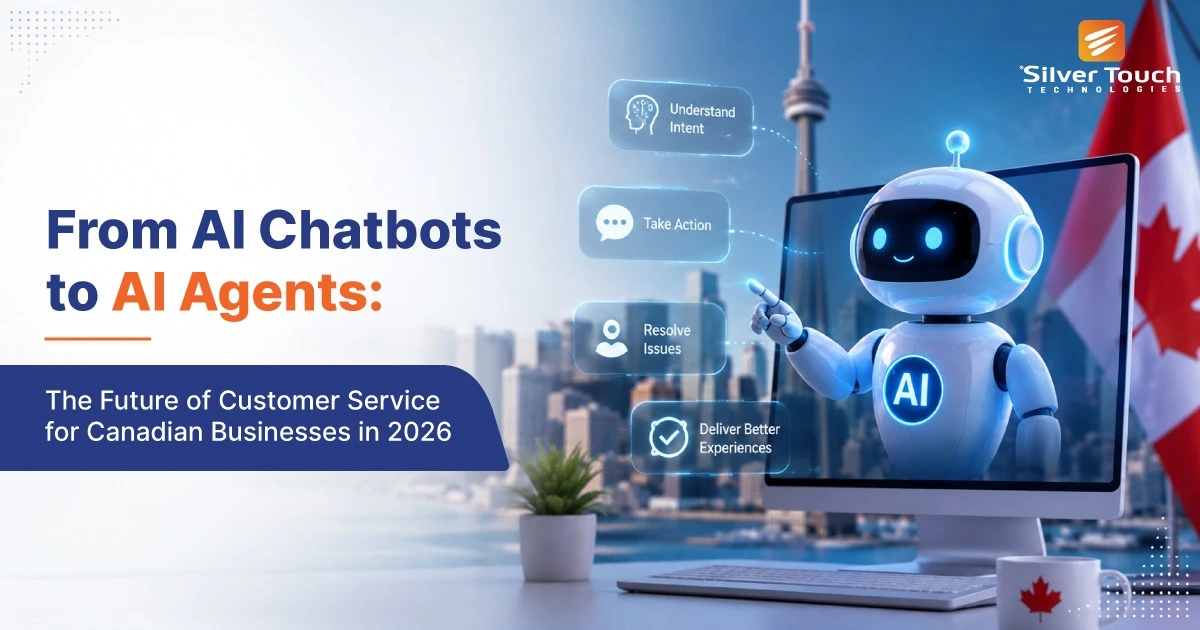
That’s the gap AI agents close in 2026. An agent understands what the customer wants, connects to the systems that hold the answer, and finishes the job in one conversation. At Silver Touch Technologies, we spend most of our time on the unglamorous half of that equation: the ERP, CRM and back-office plumbing that makes an agent useful. This guide is what we’ve learned, written for Canadian businesses deciding what to do next.
AI chatbot vs AI agent: the honest difference
Vendors blur these two terms, so here’s a plain test. Ask the tool to do something that requires changing a record in one of your systems. A chatbot will send a link or a phone number. An agent will make the change, within the limits you set, and confirm it.
| Traditional chatbot | AI agent | |
|---|---|---|
| How it works | Scripts, decision trees, keyword matching | Understands intent and plans the steps |
| What it can touch | Your FAQ page | Your ERP, CRM, order, billing and booking systems |
| Typical outcome | “Here’s a link to our returns policy” | “Your return is approved and the label is in your inbox” |
| When it’s stuck | Loops or gives up | Asks a clarifying question or hands off |
| Handoff to staff | Customer starts over | Staff get a summary of what’s been tried |
Picture a home-goods retailer in Mississauga in the week before Christmas. A customer writes in French at 11 p.m. asking why her order hasn’t shipped. A chatbot replies in English with a tracking page. An agent replies in French, sees in the ERP that one item is backordered, offers to ship the rest today, and updates the order once she agrees. The difference isn’t the language model. It’s the access.
Why 2026, and not two years ago
In 2024, most “AI agents” we tested were impressive in a demo and unreliable in production. They lost track of long conversations and made up answers when a system didn’t respond. Today’s models follow instructions far more consistently and know when to stop and ask. That’s the change that matters for customer service, where one wrong refund costs more than a hundred correct answers save.
The second change is cost. Agent features now ship inside help desk and CRM platforms many Canadian companies already pay for, and the cloud services needed to run them are available in Canadian regions on both Azure and AWS. A mid-sized business can pilot an agent in weeks, not quarters.
And the pressure hasn’t eased. Customers expect answers at midnight, while frontline support roles in retail, healthcare administration and utilities remain hard to fill and harder to keep. Agents won’t solve staffing, but they can take the repetitive volume off people who are tired of resetting passwords.
The part nobody shows in the demo: your back office
Every AI agent demo looks smooth, because the demo runs on clean sample data. Your business doesn’t. Inventory lives in SAP or Odoo, customer history sits in a CRM, invoices are in another system, and some critical steps still happen in a spreadsheet someone emails on Fridays.
An agent is only as capable as the systems it can reach. If it can’t see real stock levels, it can’t offer a substitute. If billing and the CRM disagree, it will confidently give the wrong answer. In our experience, most of the work in a successful agent project isn’t the AI at all. It’s integration, data cleanup, and deciding exactly which actions the agent is allowed to take.
This is where we spend our time at Silver Touch. Our team has delivered ERP, cloud, RPA and AI projects across Canada, the U.S., the U.K. and India. For customer service, that usually means:
- Connecting the agent securely to SAP, Odoo, Microsoft Dynamics or your existing CRM
- Using RPA to bridge older systems that have no modern API
- Setting guardrails, such as refunds above a set amount always going to a person
- Hosting on Azure or AWS Canadian regions when data residency matters
Three Canadian realities to plan for
Most AI customer service advice online is written for the U.S. market. Canada adds a few requirements you can’t bolt on later.
1. French has to be good, not just present
If you serve Quebec, the Charter of the French Language, strengthened by Bill 96, sets firm expectations for French-language service. Modern agents handle French well, but test with Québécois phrasing and real customer messages, not textbook French. A clumsy translation tells customers they’re an afterthought.
2. Privacy rules shape the design
PIPEDA governs how you collect and use personal information, and Quebec’s Law 25 adds transparency duties around automated decisions. Before launch, you should be able to answer three questions: what data the agent can see, where it’s stored, and how customers know they’re talking to AI. We build those answers into the architecture rather than the privacy policy.
3. You own what your AI says
In Moffatt v. Air Canada (2024), a B.C. tribunal ordered the airline to honour refund information its website chatbot got wrong. Air Canada argued the bot was responsible for its own statements. The tribunal didn’t accept that. The lesson for every Canadian business is that an agent must be grounded in current, approved policies, and tested hard before customers see it.
Canada also has no single federal AI law yet, since the proposed Artificial Intelligence and Data Act died when Parliament was prorogued in early 2025. Following existing privacy and consumer protection rules carefully now is the best preparation for whatever comes next.
Where people still matter most
The best agent projects we’ve seen don’t measure success by how many staff they replaced. They measure how much better the remaining conversations got.
Someone disputing a charge after a death in the family doesn’t want efficiency. They want a person who listens. A good agent recognises those moments and steps aside, passing along everything it has already gathered, so the customer never has to say “as I already explained” again. Meanwhile, the routine requests that make up most of your volume get resolved in seconds, at any hour.
Two rules keep it human. Always tell customers they’re talking to AI. And make reaching a person easy, with no hidden menus or loops designed to wear people down. How we take a business from chatbot to agent
There’s no need to rebuild your support operation in one go. This is the path we follow with clients, and it works for a 20-person distributor as well as a national brand.
- Read the tickets, not the wish list. We review three months of emails, chats and call notes to find the five requests that eat the most staff time. Order status and booking changes almost always make the cut.
- Map the systems behind each request. For every task, we trace which ERP, CRM or billing records the agent needs to read or change, and where integration or RPA is required.
- Pilot one task, with limits. One use case, clear guardrails, and a human approving anything risky. A focused pilot can usually go live in weeks, not months.
- Test like a frustrated customer. Typos, slang, sarcasm, both official languages and edge cases your policies don’t cover. If it breaks in testing, it won’t break in front of a customer.
- Measure resolution, then expand. We track issues fully resolved, handoff rate and customer satisfaction, not just chat volume. Once the first task earns trust, we add the next.
Ready to move past the FAQ bot?
The shift from chatbots to AI agents isn’t really about AI. It’s about finally connecting customer conversations to the systems where the work gets done. Canadian businesses that get the integration, the language and the privacy right will offer service their competitors can’t match, without burning out their teams.
Silver Touch Technologies Canada helps businesses design, integrate and run AI agents that work with the systems they already have, from SAP and Odoo to Azure, AWS and custom CRMs. We’re based in Markham, Ontario, and we work with clients across the country.
Book a free AI customer service assessment. Send us your top five support requests, and we’ll show you which ones an agent could resolve, what it would need to connect to, and a realistic plan for your first pilot. Contact the Silver Touch team.