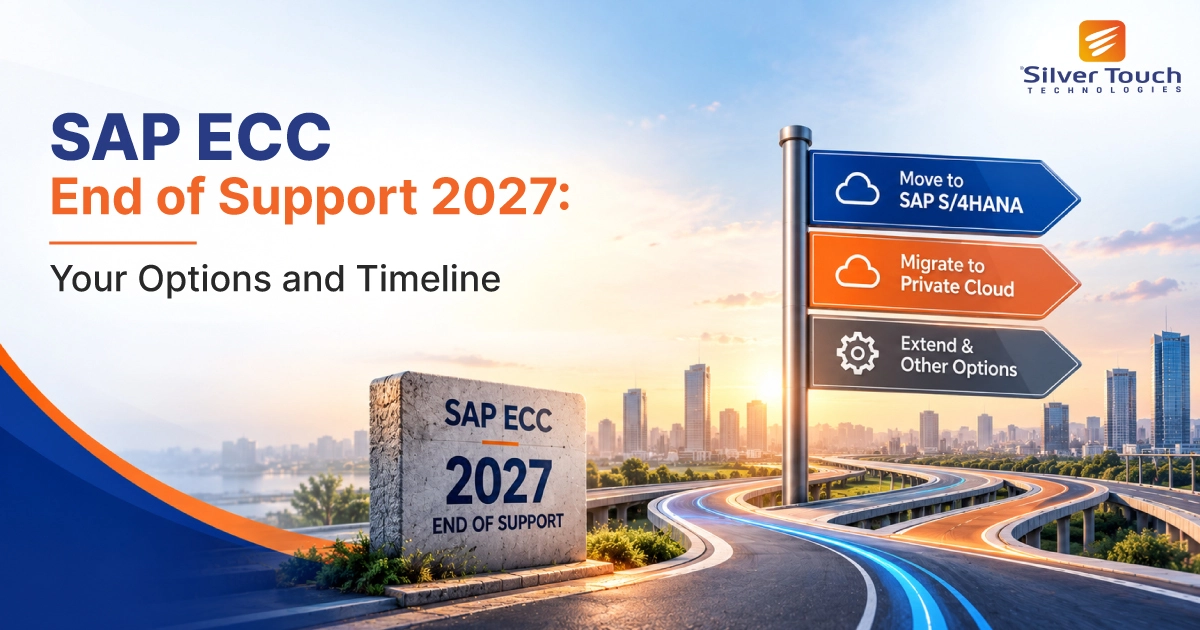
SAP ECC End of Support 2027: Your Options and Timeline
The clock is ticking louder than most teams admit
If your business still runs on SAP ECC, you have probably heard about the 2027 deadline in at least a dozen meetings. Maybe it got nodded at, pushed to next quarter, and quietly parked again. You are not alone. Plenty of finance, supply chain and IT leaders are in exactly the same spot.
Here is the honest reality. SAP ECC end of support in 2027 is not a rumour, and SAP has said it will not move the date again. Mainstream maintenance for ECC 6.0 ends on 31 December 2027. That is about 14 months from now, and a typical S/4HANA project takes longer than that.
The good news? You still have real choices. This guide walks you through the timeline, every option on the table, and how to pick the one that fits your business rather than SAP’s sales targets.
What does SAP ECC end of support really mean?
Let’s clear up the biggest myth first. Your ECC system will not switch off on 1 January 2028. Invoices will still post and plants will still run.
What ends is SAP’s default safety net. After 2027, ECC moves out of the standard path and into “exception mode”. Support becomes more expensive, narrower in scope, and fixed to an expiry date.
The deadline covers ECC 6.0 on enhancement packages 6, 7 and 8, plus the wider Business Suite 7 family: CRM, SCM and SRM. If you run older enhancement packages, your mainstream support has already ended.
In practical terms, staying on ECC without a plan means:
- Rising costs. Extended maintenance adds two percentage points to your maintenance fee.
- Shrinking coverage. After 2030, standard customer-specific maintenance delivers no new legal or tax updates.
- Growing security risk. Fewer patches for a system that holds your most sensitive financial data.
- A talent squeeze. Experienced ECC consultants are moving to S/4HANA work, and rates are climbing.
Why waiting is riskier than it looks
It is tempting to think extended maintenance gives you breathing room. In a narrow sense it does. But the maths of a migration project tells a different story.
A mid-sized S/4HANA programme usually needs 12 to 18 months from kickoff to go-live, and large global rollouts often run two years or more. Add three to six months for partner selection, budgeting and board approval, and a project that starts in mid-2027 is already chasing the 2030 line.
There is also a capacity problem. Thousands of SAP customers face the same dates, and the pool of experienced S/4HANA architects, functional consultants and testers is limited. As demand peaks, the best teams get booked first and day rates rise. Companies that wait often end up paying more for less experienced people, on a compressed timeline, with less room to fix problems before go-live.
Finally, every month on ECC is another month of building workarounds, reports and integrations on a platform you plan to leave. That is effort you will pay for twice.
Your five options after SAP ECC end of support
1. Migrate to SAP S/4HANA
This is the long-term destination for most SAP customers, and there are three main ways to get there:
- Greenfield (new implementation). Start fresh with clean processes and standard best practice. Ideal if your ECC system is heavily customised or your business has changed a lot.
- Brownfield (system conversion). Convert your existing system, keeping your history and custom code. Faster and less disruptive, but you carry old baggage with you.
- Selective data transition (bluefield). A hybrid that lets you redesign some processes while moving selected data. Popular with large groups after mergers or carve-outs.
Best for: companies that want a platform built for the next 15 to 20 years and are ready to invest in proper process work.
2. RISE with SAP or GROW with SAP
RISE with SAP bundles S/4HANA Cloud, private edition, with infrastructure, tools and support under one subscription. GROW with SAP is the public cloud route, designed for mid-sized companies happy to adopt standard processes. Both shift you from perpetual licences to a subscription model, so check the contract terms carefully.
Best for: organisations that want one contract, predictable costs and less infrastructure to manage.
3. Extended maintenance until 2030
If you are on EHP 6 or above, you can pay for extended maintenance from 2028 to 2030. You keep security patches and legal changes, but no new innovation. It works well as a bridge. It fails as a strategy.
Best for: teams with a migration already planned for 2028–2030 who need cover while they finish.
4. SAP ERP, private edition, transition option (to 2033)
Aimed at large, complex landscapes, this option moves ECC into SAP’s private cloud on a HANA database by the end of 2030, then supports it until 2033. Customers who committed by the end of 2025 get equivalent commercial terms; 2026 sign-ups face a 20 percent uplift. You also need to pass an SAP readiness check and accept that S/4HANA is the endpoint.
Best for: very large enterprises with complex landscapes that cannot realistically finish before 2030.
5. Third-party support
Providers such as Rimini Street offer ECC support beyond SAP’s dates, often at around half the cost. It can free budget for innovation, but you lose access to SAP upgrades. Returning to SAP later may trigger back-maintenance fees.
Best for: stable businesses that want to cut run costs now and plan a cloud move on their own schedule.
What you actually gain from S/4HANA
It is easy to treat this whole exercise as a compliance chore. That is a mistake, because S/4HANA is a genuinely different system, not just ECC with a new coat of paint.
- Real-time reporting. The in-memory HANA database lets finance and operations work from live numbers instead of overnight batch reports.
- A simpler data model. The Universal Journal merges finance and controlling into one table, removing many reconciliations and speeding up the month-end close.
- A modern user experience. SAP Fiori apps work on any device and are far easier for new staff to learn than classic SAP GUI screens.
- Built-in intelligence. Embedded analytics, machine learning and SAP’s Joule AI assistant are only available on the new platform.
- A cleaner core. A well-run migration lets you retire years of custom code and keep extensions outside the core, which makes future upgrades much easier.
Frame your business case around these gains, not just around avoiding a support deadline. Boards approve investments that promise better outcomes far more readily than ones that simply avoid risk.
What should you budget for?
Licence or subscription fees are only part of the picture. When you build your budget, make sure it covers:
- Implementation partner fees for design, build and go-live
- Data cleansing and migration, which is often underestimated
- Custom code remediation and integration rework
- Testing, including at least two full rehearsal cycles
- Training and change management for end users
- A period of running ECC and S/4HANA side by side
A sensible rule is to add a 15 to 20 percent contingency. Migrations rarely fail on technology; they overrun on data, testing and people.
Common mistakes to avoid
- Reading 2033 as “we have years left”. The transition option is narrow, conditional and paid. For most mid-market firms, 2027 and 2030 are the real deadlines.
- Treating it as an IT project. S/4HANA changes how finance, procurement and logistics work. Business owners need a seat at the table from day one.
- Lifting and shifting bad habits. Moving 20 years of custom code without review wastes the biggest chance you will get to simplify.
- Ignoring contract fine print. Extended maintenance is hard to exit mid-term, and RISE means giving up perpetual licences.
Final thoughts: turn a deadline into an advantage
The SAP ECC end of support in 2027 can feel like a burden. But companies that plan now get to choose their partners, their pace and their price. Those that wait will take whatever is left in a crowded 2029 market.
Start small: an inventory, a readiness check and one honest conversation about where your business is heading. That alone puts you ahead of most of your peers.
Need help mapping your ECC exit? Talk to our SAP experts for a free readiness assessment and a clear, costed roadmap.