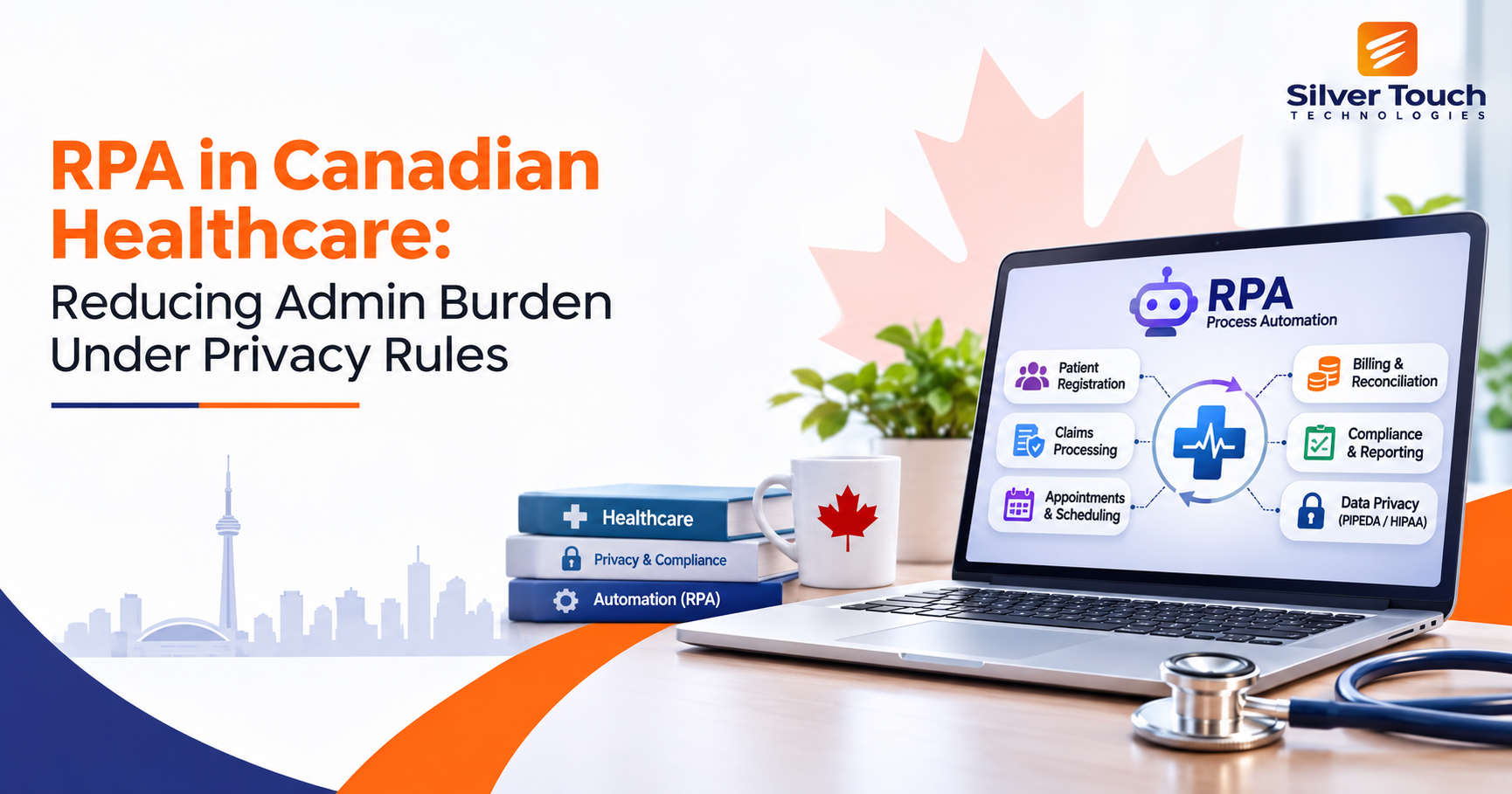
Canadian healthcare providers are under growing pressure. Clinician shortages, rising patient volumes, and tightening budgets have made administrative efficiency a strategic priority rather than a back office concern. Studies consistently show that healthcare workers spend a significant share of their day on paperwork, data entry, and manual coordination tasks that pull them away from patient care.
Robotic Process Automation (RPA) offers a practical path forward. By deploying software bots that handle repetitive, rules based tasks, healthcare organizations across Canada are reclaiming thousands of hours each year while strengthening compliance with the country’s layered privacy framework. This blog explores how RPA is reducing healthcare admin burden in Canada and why privacy first implementation matters.
Understanding RPA in Healthcare
RPA uses software bots to perform structured, repetitive tasks that would otherwise require manual effort. Unlike full scale artificial intelligence, RPA follows predefined rules and works through existing system interfaces without replacing underlying infrastructure. This makes it a low risk entry point for organizations that want to modernize without overhauling their IT stack.
In practice, an RPA bot can log into an electronic health record (EHR), extract patient data, populate a claims form, verify insurance eligibility, and route the completed file to the next step in the workflow. It does this faster and more consistently than manual processing, running around the clock without fatigue. The global healthcare RPA market reflects this momentum, with industry analysts projecting growth from USD 2.80 billion in 2025 to more than USD 22 billion by 2034.
For Canadian providers, the appeal is especially strong. Provincial health systems face persistent staffing gaps, and administrative overhead consumes resources that could be redirected to frontline care. RPA addresses this gap directly by automating the tasks that contribute most to burnout and backlogs.
The Canadian Privacy Landscape
Any automation initiative that touches patient data in Canada must navigate a layered privacy framework. At the federal level, the Personal Information Protection and Electronic Documents Act (PIPEDA) governs how private sector organizations collect, use, and disclose personal information during commercial activities. PIPEDA applies to healthcare entities engaged in interprovincial or commercial operations and sets baseline consent, transparency, and accountability requirements.
At the provincial level, dedicated health privacy statutes add further obligations. Ontario’s Personal Health Information Protection Act (PHIPA) requires explicit consent before collecting, using, or disclosing personal health information, with strict circle of care provisions and breach notification duties. Organizations face fines of up to CAD 1,000,000 for violations, while individuals can be penalized up to CAD 200,000 or face imprisonment. Alberta’s Health Information Act (HIA) similarly regulates custodians who handle health information, requiring privacy impact assessments before implementing new systems. British Columbia, Quebec, New Brunswick, and other provinces maintain their own frameworks with comparable protections.
This regulatory patchwork means that RPA deployments cannot take a one size fits all approach. Bots that access, transfer, or store personal health information must be designed with privacy built into every workflow from the outset.
Key Use Cases for RPA in Canadian Healthcare
Patient Scheduling and Appointment Management
RPA bots can match patient requests to clinician availability in real time, offer open slots, process cancellations, and send automated reminders. This reduces no show rates and frees front desk staff to focus on in person patient interactions rather than phone based coordination.
Claims Processing and Billing
Claims management is one of the most labour intensive functions in healthcare administration. RPA can automate up to 85 to 95 percent of manual claims tasks, including pulling diagnosis codes from EHRs, populating billing forms, cross referencing fee schedules, and submitting claims to provincial health insurance plans. The result is faster reimbursement cycles and fewer rejected claims.
Insurance Eligibility Verification
Before a patient visit, bots can extract patient identifiers from the clinical system, query insurance databases, confirm coverage details, and flag discrepancies for staff review. This pre visit automation eliminates a common bottleneck that delays care and creates billing errors.
Lab Results Routing and Referral Management
RPA can monitor incoming lab results, match them to patient records, notify the ordering physician, and update the patient portal. Similarly, referral workflows benefit from automation that tracks referral status, sends follow up communications, and ensures documentation is complete before the specialist appointment.
Regulatory Reporting and Compliance Documentation
Canadian healthcare providers must meet reporting obligations to provincial ministries of health, regional health authorities, and accreditation bodies. RPA bots can extract required data points from clinical and financial systems, compile reports in the mandated format, and flag anomalies for human review before submission.
Privacy First RPA Implementation
Deploying RPA in a regulated Canadian healthcare environment requires deliberate design choices that embed privacy protections into every automated workflow.
Comprehensive Audit Trails
Every action an RPA bot performs should be logged with timestamps, user context, and data elements accessed. These audit trails support compliance investigations, breach response protocols, and the accountability requirements under PIPEDA and provincial health privacy statutes. Regulators expect organizations to demonstrate exactly how personal health information was handled, and automated logging delivers this transparency without additional manual effort.
Data Minimization and Purpose Limitation
RPA workflows should be configured to access only the minimum data elements required for each task. A bot processing a claims submission does not need to retrieve a patient’s full medical history. By restricting data access at the workflow level, organizations reduce their exposure in the event of a security incident and align with the purpose limitation principles embedded in Canadian privacy law.
Encryption and Access Controls
Personal health information processed by RPA bots must be encrypted both in transit and at rest. Role based access controls should govern which bots can interact with which data sets, and credentials should be managed through secure vaults rather than hard coded into automation scripts. Multi factor authentication for bot management consoles adds another layer of protection.
Privacy Impact Assessments
Before deploying any RPA workflow that handles personal health information, organizations should conduct a formal privacy impact assessment (PIA). This is a regulatory expectation in several provinces, including Alberta, and it is a best practice across Canada. A PIA identifies risks, documents mitigation strategies, and creates a record of due diligence that strengthens the organization’s compliance posture.
Real World Impact
Healthcare organizations that have adopted RPA report measurable improvements across operational and financial metrics. Administrative task processing times have been reduced by 30 to 50 percent in documented deployments, with some organizations recovering more than 1,500 manual hours per month. The CAQH 2024 Index estimated that the healthcare industry could save more than USD 20 billion through broader adoption of electronic and automated administrative transactions.
Beyond cost savings, RPA delivers qualitative benefits that matter in the Canadian context. Staff satisfaction improves when clinicians and administrative teams are freed from repetitive data entry. Patient experience improves when scheduling is faster, wait times for eligibility confirmation shrink, and appointment reminders reduce missed visits. Compliance teams gain confidence from automated audit trails and consistent documentation practices.
First year return on investment for healthcare RPA projects typically ranges from 30 to 200 percent, depending on the scope and complexity of the workflows automated. Quick win processes such as eligibility verification and appointment reminders often deliver results within weeks of deployment, building organizational momentum for broader automation programs.
Getting Started with Compliant RPA Adoption
Canadian healthcare organizations considering RPA should follow a structured approach that balances operational ambition with regulatory discipline.
The first step is conducting an automation readiness assessment. This involves mapping existing administrative workflows, identifying high volume and rules based tasks that are strong candidates for automation, and evaluating the current state of data governance and IT infrastructure.
Next, organizations should start with quick win processes. Appointment reminders, eligibility verification, and standard report generation are low complexity workflows that deliver visible results quickly and help build internal support for the program.
A centre of excellence or governance structure should be established early. This cross functional team, typically including IT, operations, compliance, and clinical leadership, oversees bot development, manages change, and ensures that every workflow meets privacy requirements before it goes live.
Finally, organizations must redesign broken processes before automating them. Automating an inefficient workflow only produces faster inefficiency. Process optimization should precede bot deployment, ensuring that the automated version reflects current best practices and regulatory expectations.
Conclusion
The administrative burden in Canadian healthcare is not just an operational inconvenience. It directly affects patient outcomes, staff retention, and financial sustainability. RPA provides a proven, scalable solution that automates the repetitive tasks consuming valuable clinical and administrative time while maintaining strict compliance with PIPEDA, PHIPA, HIA, and other provincial privacy frameworks.
The key to success lies in treating privacy as a design principle rather than an afterthought. Organizations that embed audit trails, data minimization, encryption, and formal privacy impact assessments into their RPA programs will not only meet regulatory expectations but also build lasting trust with patients and staff.
Silvertouch Technologies Canada helps healthcare organizations plan, implement, and scale RPA solutions that are built for the Canadian regulatory environment. Contact us to explore how RPA can reduce your administrative burden while keeping patient data secure.